According to a frequently repeated story, during the early years of the Zionist movement a number of Jews from Europe were sent to the Land of Israel/Palestine to investigate its suitability for reestablishing Jewish sovereignty. They reported back, the story concludes, that “the bride is beautiful but she is married to another man“ — the land is excellent, but belongs to others.
Though there are no known primary sources for any of the several variations of this story, they have continued to be recounted as historical fact by scholars, journalists, filmmakers, and artists — including Avi Shlaim, Rawan Damen, Rula Halawani, Ilan Pappé, Yasmeen Abu-Laban, and Abigail B. Bakan — usually as part of deliberate efforts to delegitimize the state of Israel and, by now, often with full awareness that the stories are baseless.
The “bride is beautiful but she is married to another man” stories efficiently work to situate the rise of political Zionism as a deliberate injustice accountable for the ills of the region’s modern history, and as uniquely responsible for producing the space in which ensuing ruinous events in the Middle East have unfolded — with the implication that the Jewish state, which ought never have come into being, should now be dissolved and its replacement become the world’s twenty-second Arab and forty-seventh Muslim-majority country.
The ubiquity of “The bride is beautiful, but she is married to another man” stories presents a troubling illustration of the shoddiness found in Middle Eastern studies and of how scholars, journalists, and filmmakers regularly dispense with accuracy and evidentiary standards when dealing with Jewish, Zionist, and Israeli history. Professionalism is often intentionally put aside to advance political agendas and as part of efforts to delegitimize the Jewish state, and this approach has become so entrenched that fictions are relied upon even when documented events could be made to serve such purposes instead.
Though stories incorporating the phrase “The bride is beautiful, but she is married to another man” lack a primary source, and though there has been no basis for recounting them as historical events that occurred during the early years of the Zionist movement, different versions appear in many articles, books, and films.
Some authors are unwilling to dispense with unsubstantiated stories, opting instead to put scholarly standards aside in their attempts to advance anti-Zionist arguments. One case in point is the “married to another man” fable.
Shofar: An Interdisciplinary Journal of Jewish Studies 30:3, Spring 2012, pp. 35–61
While its details vary with the telling, the story’s central point is often the same: already in the early years of the Zionist movement, Jews recognized that it would be unjust and immoral for them to try to claim Palestine; despite this awareness, the Zionists proceeded with their plans for Jewish statehood there; from the outset, therefore, the establishment of the state of Israel was an act of severe and willful injustice.
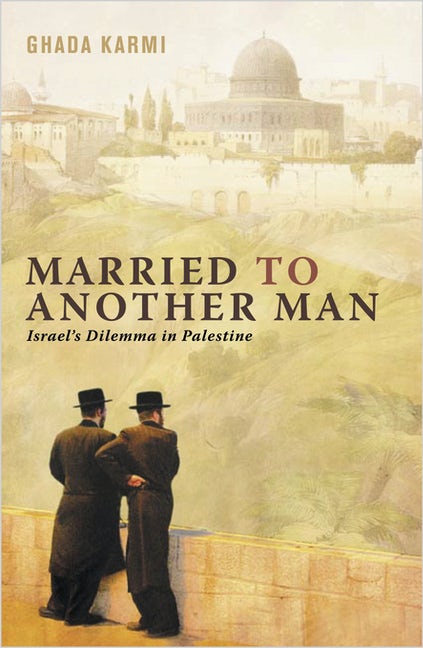
Cover of Ghada Karmi’s 2007 Married to Another Man: Israel’s Dilemma in Palestine
Cover of Ingmar Karlsson’s 2012 Bruden är vacker men har redan en man: Sionisme – en ideologi vid vägs ände? (The bride is beautiful but there is already a husband: Zionism – an ideology at the end of the road?)